
(We are reprinting a text by Jakub Woroncow, historian, journalist, and researcher of contemporary history, political extremism, and radicalization.)
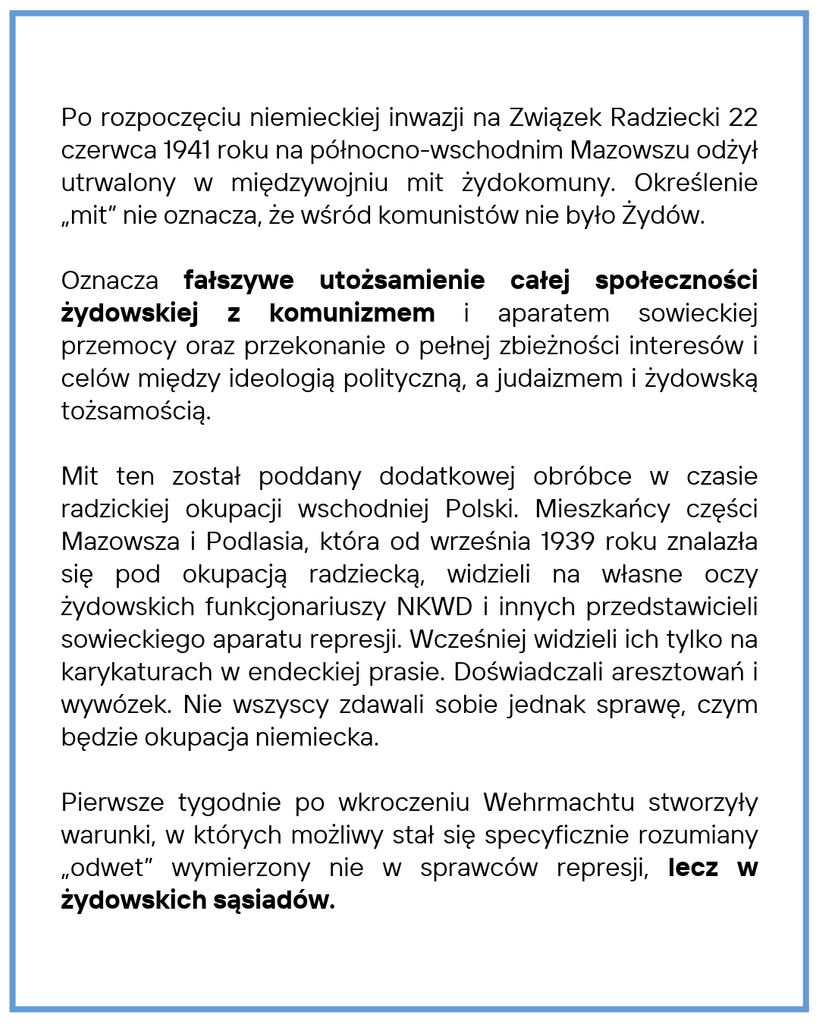
In the United States, „sundown towns” were municipalities where Black people—and sometimes also Native Americans, Mexicans, in short, people of another race—were not allowed to remain after dark. The ban was enforced by local authorities or by a mob. Often, such places became „sundown towns” following organized pogroms that forced Black residents to leave. In the 20th century, there were thousands of such places in the United States.
In Poland, we also have a sundown town. At least one. Polish Jews come to Jedwabne to commemorate the people burned alive in a barn by their Polish neighbors. Yet they must leave it as quickly as possible.
After the German invasion of the Soviet Union began on June 22, 1941, the myth of Żydokomuna („Judeo-Communism”), entrenched during the interwar period, was revived in northeastern Mazovia. Calling it a „myth” does not mean there were no Jews among the communists. Rather, it denotes the false conflation of the entire Jewish community with communism and the apparatus of Soviet violence, as well as the belief in a total convergence of interests and goals between political ideology and Judaism and Jewish identity.
This myth was subjected to further processing during the Soviet occupation of eastern Poland. Residents of the parts of Mazovia and Podlasie that came under Soviet occupation in September 1939 saw with their own eyes Jewish NKVD officers and other representatives of the Soviet apparatus of repression. Previously, they had only seen them in caricatures in the National Democratic (Endecja) press. They experienced arrests and deportations. However, not everyone realized what the German occupation would bring. The first weeks after the Wehrmacht entered created conditions in which a specifically understood „retaliation” became possible—directed not against the perpetrators of the repressions, but against their Jewish neighbors.
On July 10, 1941, Polish residents of Jedwabne gathered hundreds of their Jewish neighbors in the market square. The victims were beaten, humiliated, and forced to destroy a statue of Lenin that the Soviets had erected there. Later, the perpetrators drove the Jews—men, women, and children—into a barn belonging to Bronisław Śleszyński. The doors were bolted shut, and the building was set on fire. Germans were present at the scene of the crime. However, most historians believe that the direct perpetrators were the Polish residents of Jedwabne, though the extent of German complicity remains a subject of debate. The Soviets did not favor Polish Jews over Catholics or Orthodox Christians. Every religion was superstition to them, and houses of worship of various faiths suffered desecration.
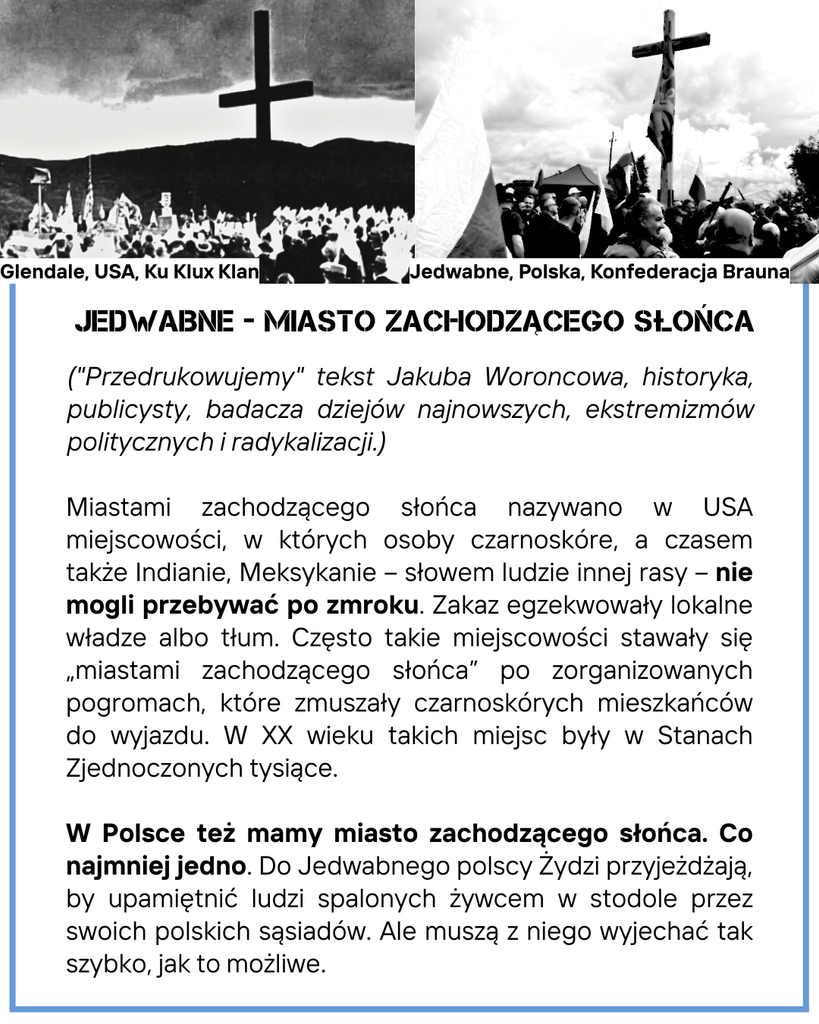
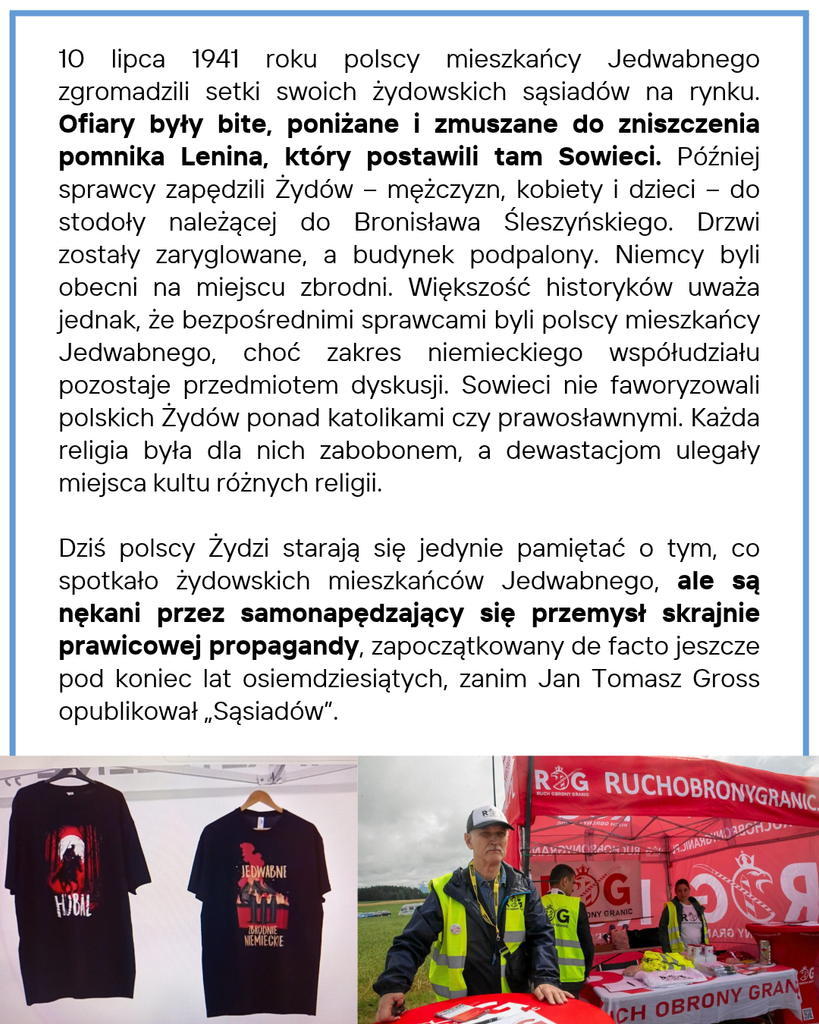
Today, Polish Jews are merely trying to remember what happened to the Jewish residents of Jedwabne, yet they are harassed by a self-perpetuating industry of far-right propaganda—one actually initiated back in the late 1980s, even before Jan Tomasz Gross published Neighbors.
I had been to Jedwabne before, but this time I came for the observances for the first time. I had not announced my arrival beforehand. Fortunately, the Chief Rabbi of Poland recognized me in the crowd and allowed me onto the grounds of the ceremony, but before that happened, I wandered around the town for quite a while observing the mood.
„Are you a Pole?” an older man asked me.
„No. A Russian spy,” I replied.
„Oh, that’s good.”
He smiled and walked away. He left me alone.
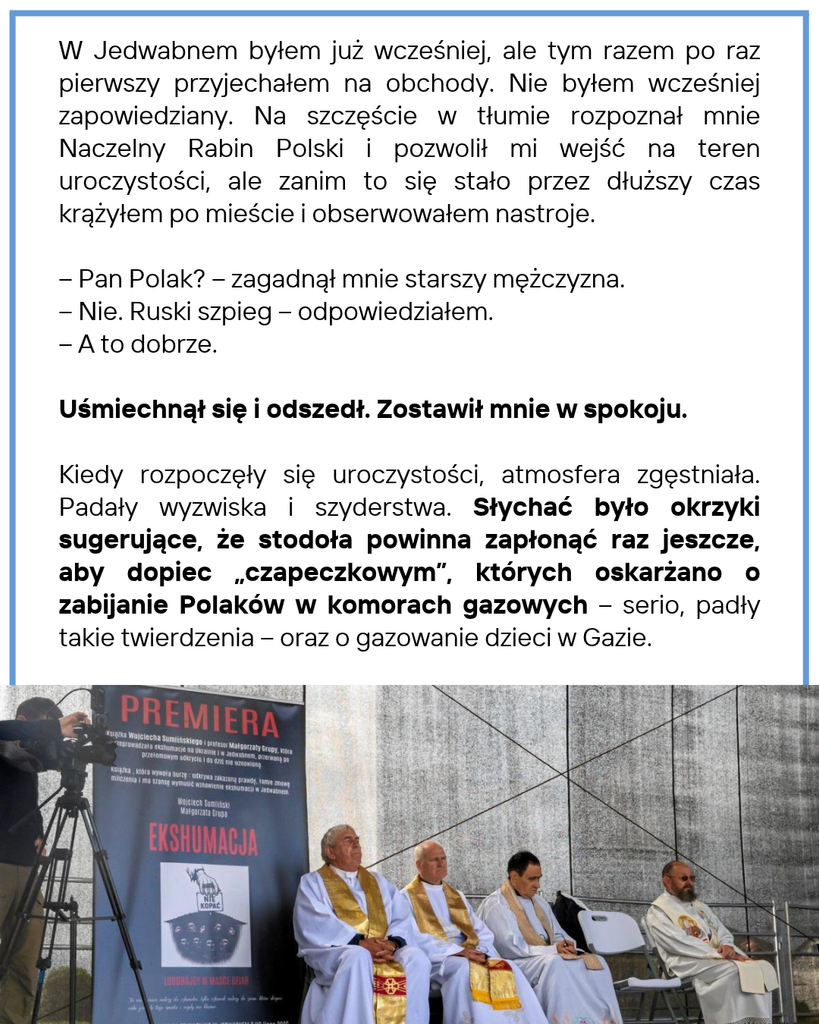
When the ceremony began, the atmosphere thickened. Insults and jeers rang out. Shouts could be heard suggesting that the barn should burn once more to get back at the „skullcap wearers,” who were accused of killing Poles in gas chambers—seriously, such claims were made—as well as gassing children in Gaza.
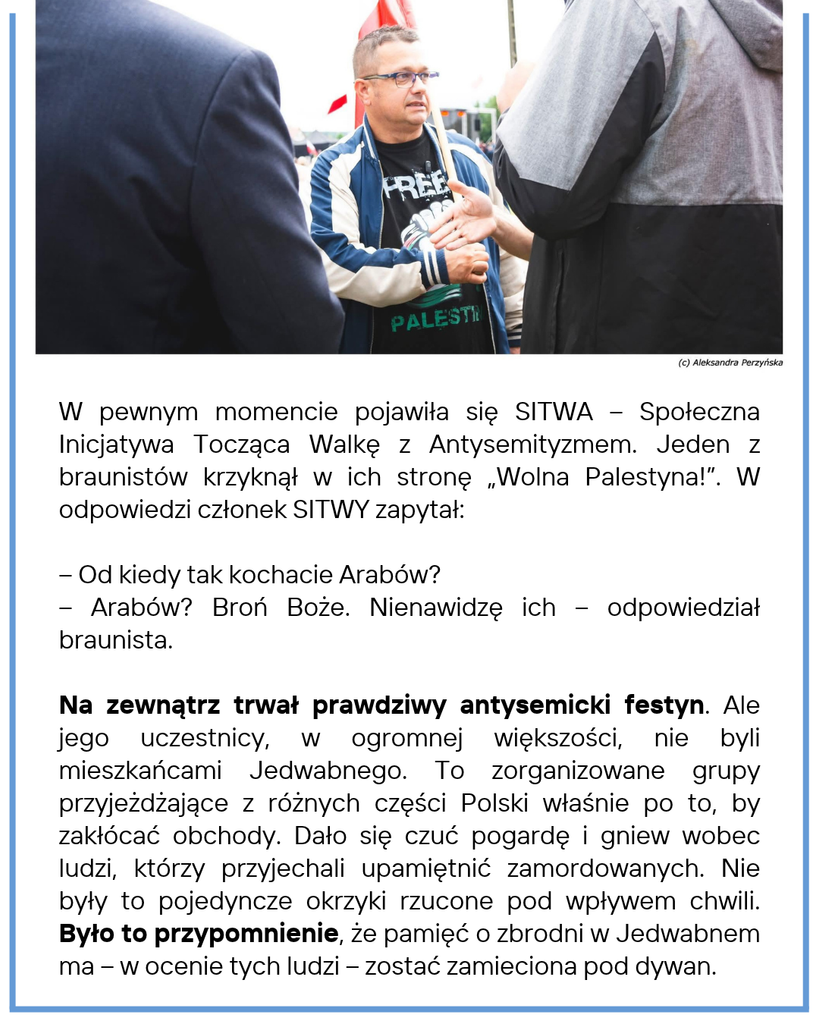
At one point, SITWA—the Social Initiative Waging the Fight Against Antisemitism—appeared. One of Grzegorz Braun’s followers shouted „Free Palestine!” in their direction. In response, a member of SITWA asked:
„Since when do you love Arabs so much?”
„Arabs? God forbid. I hate them,” the Braun supporter replied.
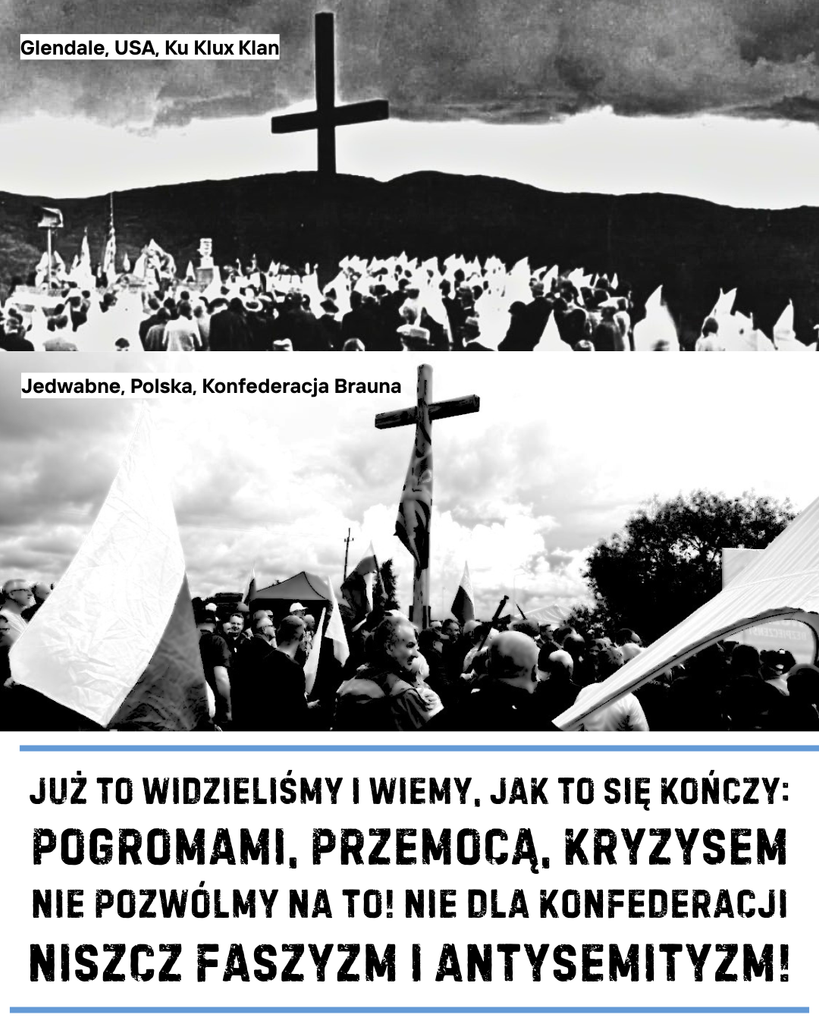
Outside, a genuine antisemitic festival was underway. Yet its participants, for the vast majority, were not residents of Jedwabne. They were organized groups arriving from various parts of Poland specifically to disrupt the observances. One could feel the contempt and anger directed toward the people who had come to commemorate the murdered. These were not isolated shouts thrown out in the heat of the moment. It was a reminder that the memory of the crime in Jedwabne is—in the view of these people—supposed to be swept under the rug.
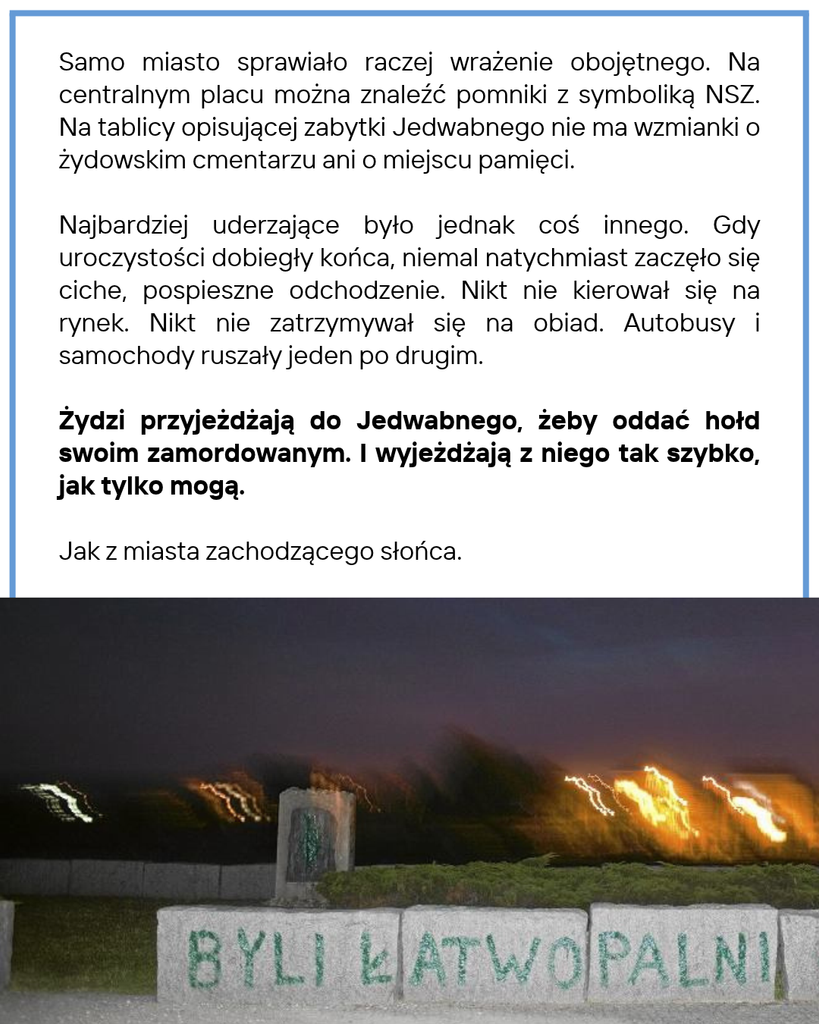
The town itself gave off an impression of indifference. On the central square, one can find monuments bearing NSZ (National Armed Forces) symbolism. On the information board describing Jedwabne’s landmarks, there is no mention of the Jewish cemetery or the memorial site.
What was most striking, however, was something else. As soon as the ceremony ended, an almost immediate, quiet, hasty departure began. No one headed toward the market square. No one stopped for lunch. Buses and cars pulled away one after another.
Jews come to Jedwabne to pay tribute to their murdered dead. And they leave it as fast as they possibly can.
Just like a sundown town.
Dodaj komentarz