
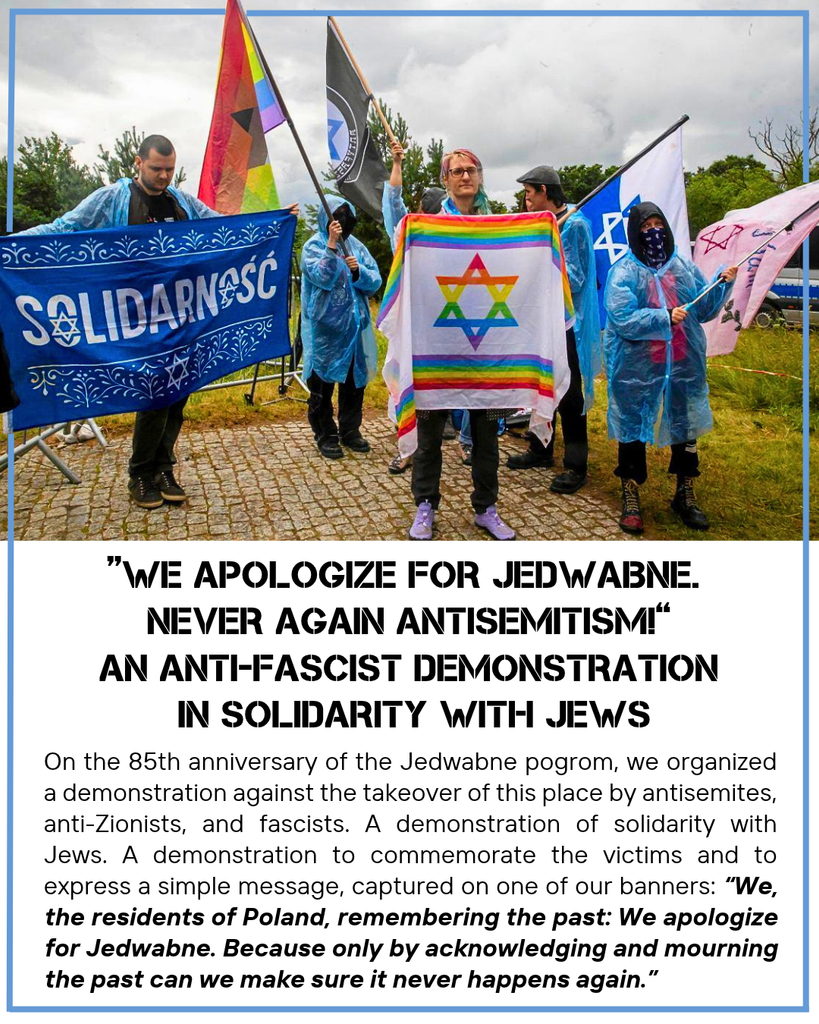
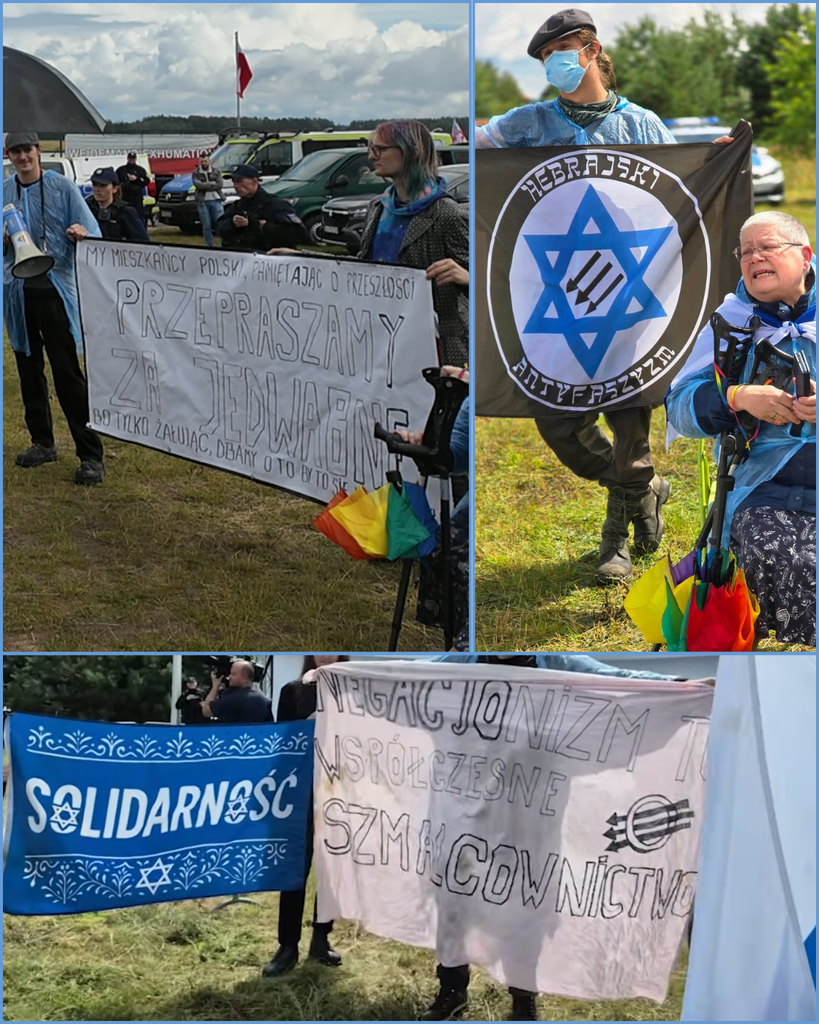
On the 85th anniversary of the Jedwabne Pogrom, we organized a demonstration opposing the takeover of this site by antisemites, anti-Zionists, and fascists—a demonstration of solidarity with Jews. A demonstration to commemorate and express the simple words we put on one of our banners:
„We, the residents of Poland, remembering the past: We apologize for Jedwabne! Because only by regretting it can we ensure it does not happen again.”
[This is the first of two texts we are preparing about Jedwabne. In this one, we focus on our actions. The activities of the antisemites, the hypocrisy of politicians, and the lies of the media will all be covered in a separate text.]
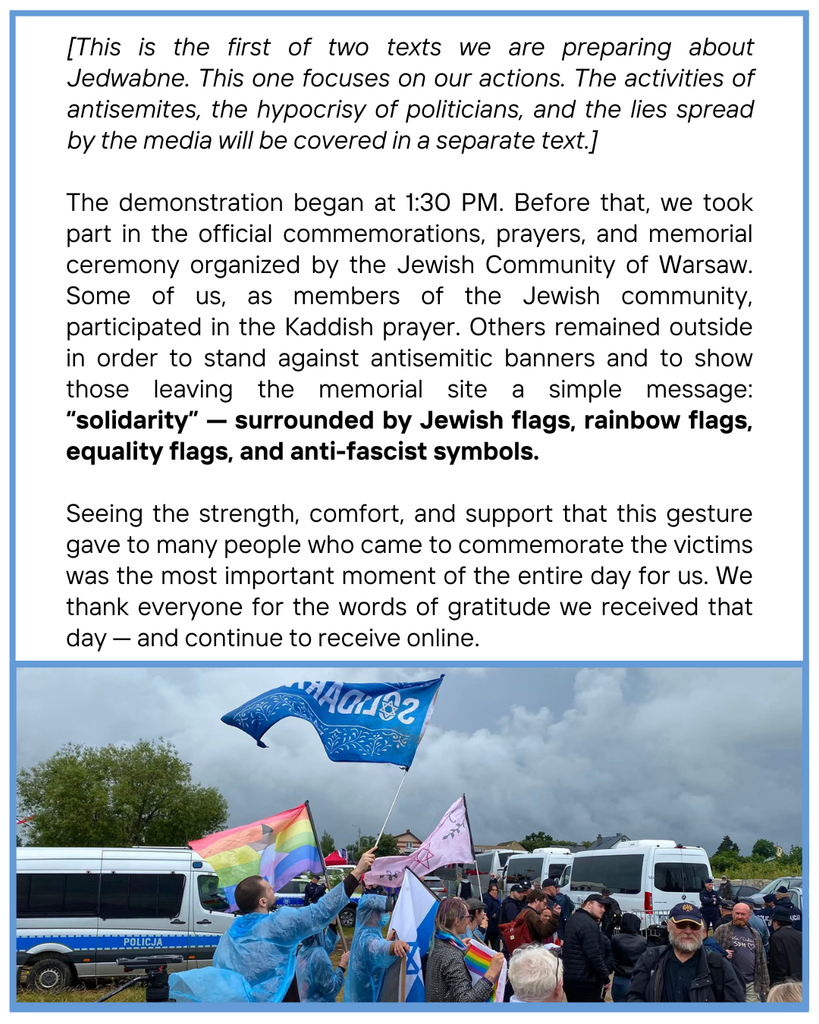
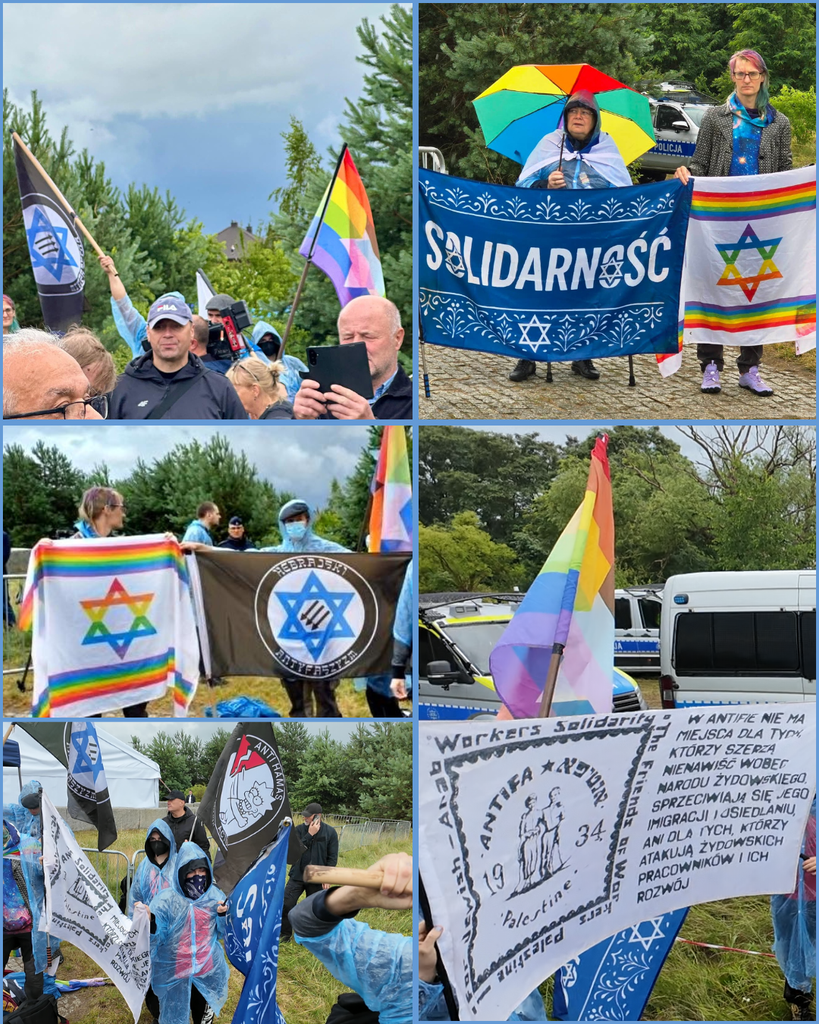
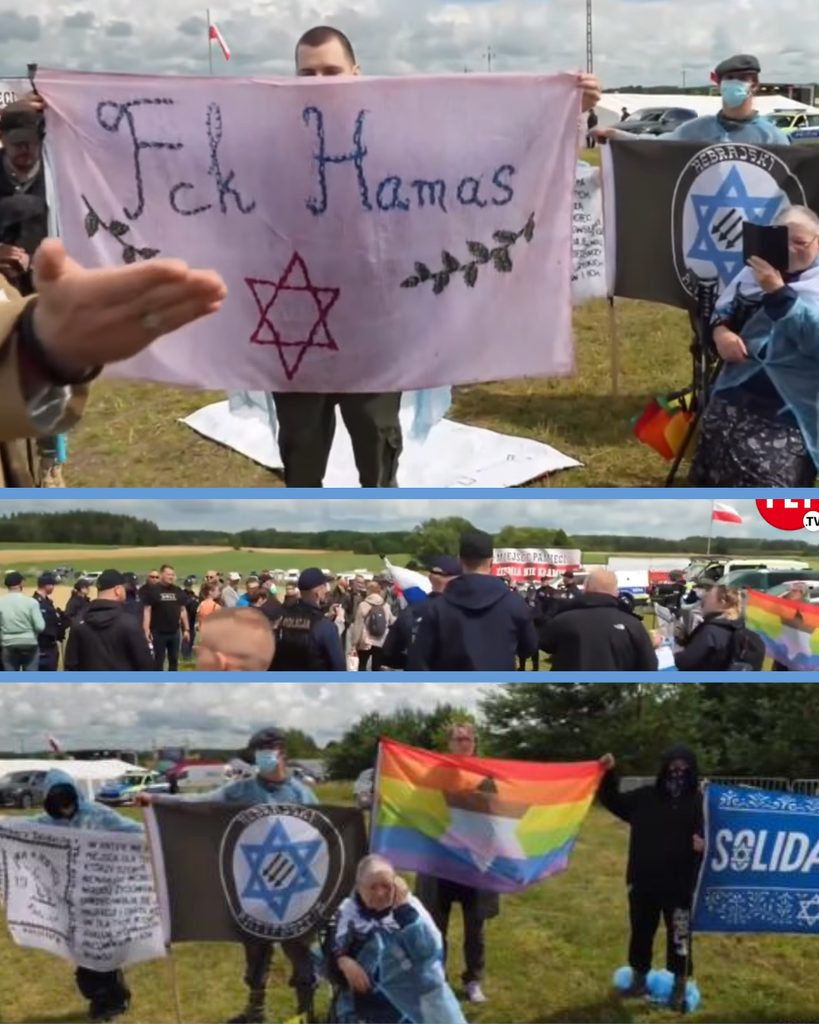
The demonstration began at 1:30 PM. Earlier, we participated in the official observances, prayers, and commemoration organized by the Jewish Community of Warsaw. Those of us who are part of the Jewish community took part in the Kaddish, while others remained outside to push back against antisemitic banners and show the Jews leaving the memorial site a simple sign reading „solidarity,” surrounded by other Jewish, rainbow, pro-equality, and antifascist flags.
Seeing the comfort and support that so many people commemorating the victims felt because of this was the most important part of the entire day for us. Thank you for all the thanks we received then and continue to receive online.
Once the Jewish community and those who wished to commemorate the day alongside them left Jedwabne, we moved to the registered location of our demonstration, closer to the Holocaust deniers. There, we turned on our sound system and finally drowned out, at least a little, the antisemitic venom and hatred that had been oozing from that place for two days. We began with an excerpt from Marian Turski’s speech at the 80th anniversary of the liberation of Auschwitz:
„So do not be afraid! In the contemporary world—today, right now—we see a massive rise in antisemitism, and after all, it was antisemitism that led to the Holocaust. Deborah Lipstadt called it a 'tsunami of antisemitism.’ And it was her courage, persistence, and perseverance in fighting Holocaust denial that ended in success after she won her trial against David Irving in London.
Let us not be afraid to show that same courage today, when Hamas attempts to deny the October 7 massacre. Let us not be afraid to stand up against conspiracy theories claiming that everything bad in the world is the result of plots hatched by unspecified social groups—and Jews are frequently named here.”
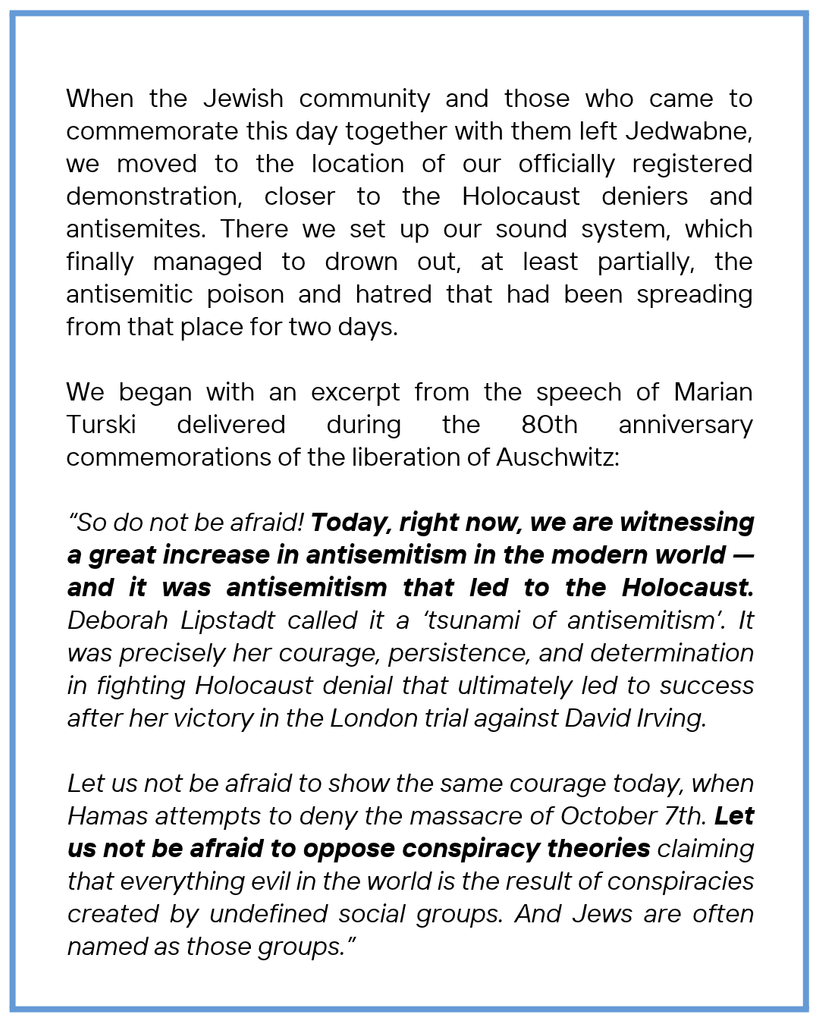
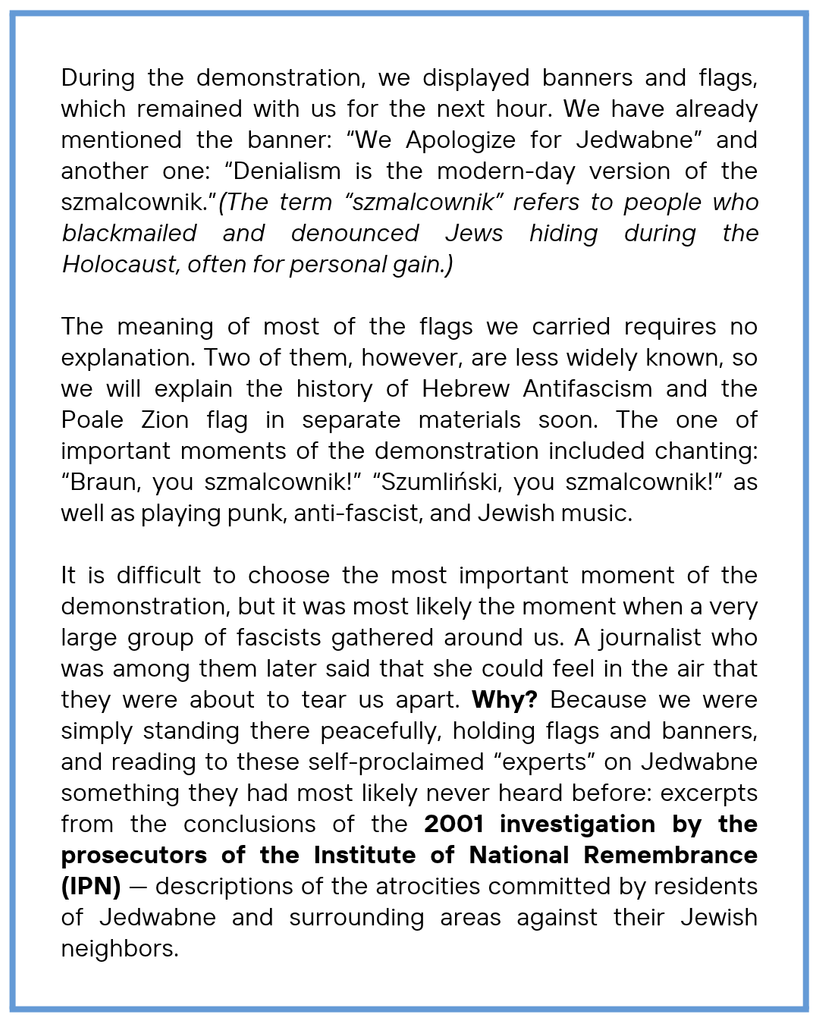
During this time, we unfurled banners and flags, standing with them for the next hour. We already mentioned the banner „We apologize for Jedwabne,” and the second one read: „Denialism is modern-day szmalcownictwo [blackmailing/betraying Jews during the Holocaust].”
The meaning of most of the flags needs no explanation. Two, however, are less obvious, which is why we will tell you about Hebrew Antifascism and the Poale Zion flag in other materials very soon.
Key moments of the demonstration included chanting slogans such as „Braun, szmalcownik!” and „Sumliński, szmalcownik!” [transcribed as Szumliński in the original], as well as playing punk, antifascist, and Jewish music.
It is hard to pick the single most important moment, but it was most likely the point when a really large group of fascists gathered right next to us. A journalist standing among them later said she could feel in the air that they were about to tear us apart. Why? Because we stood calmly with our flags and banners and read aloud to these „experts on Jedwabne” something they had most likely never heard before: excerpts from the summary of the 2001 prosecutorial investigation by the Institute of National Remembrance (IPN)—descriptions of the atrocities committed by Poles from Jedwabne and the surrounding areas against their Jewish neighbors.
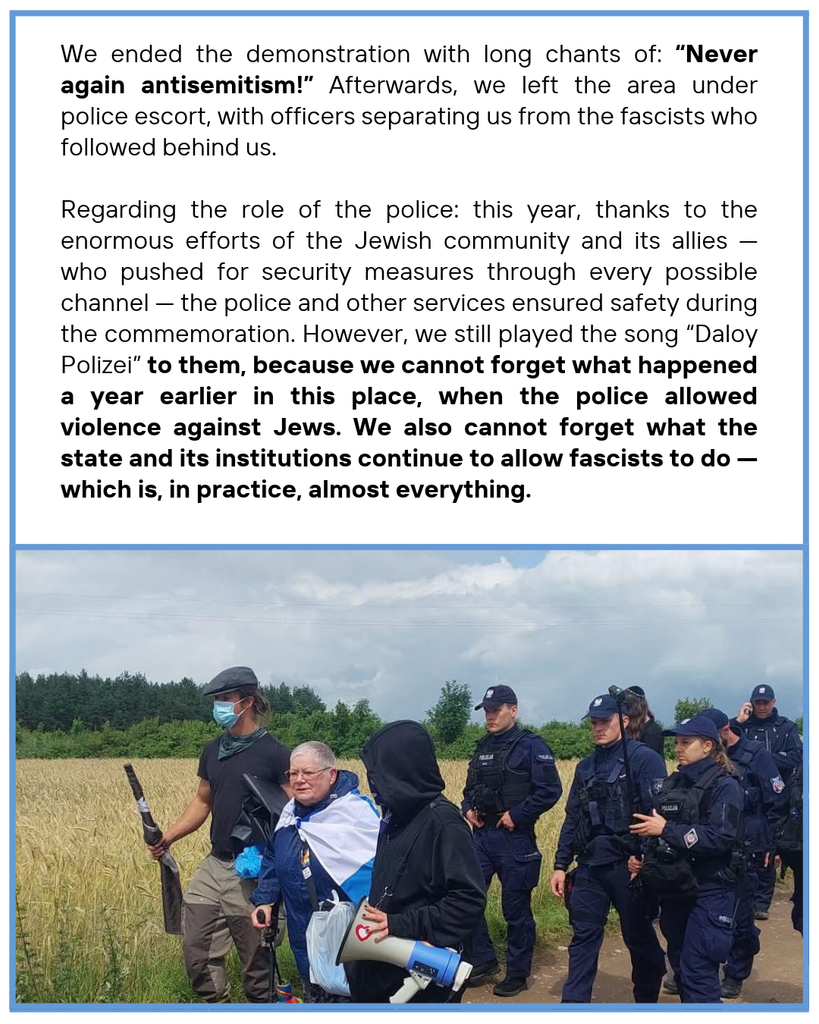
We concluded the demonstration with a long chant of „Never again antisemitism,” after which we left the area under police escort, which separated us from the fascists following behind us.
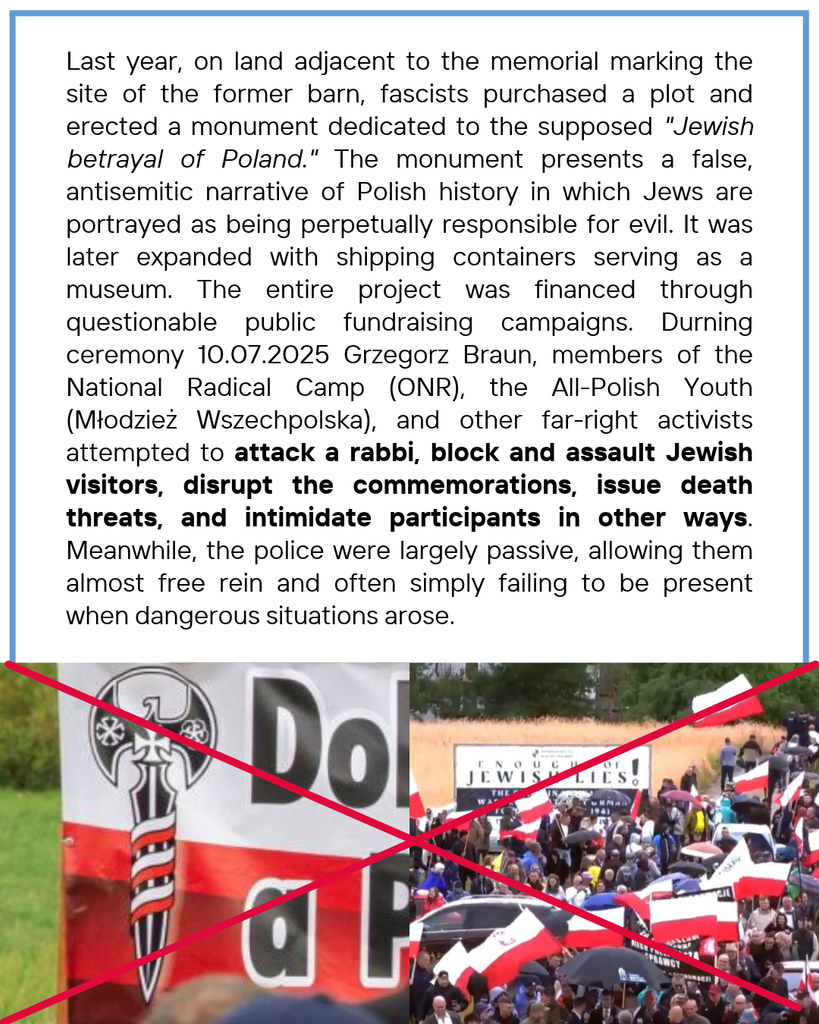
As for the role of the police, this year they and other services—thanks to the immense efforts of the Jewish community and its friends, who pressured them in every possible way—ensured safety. However, we played „Daloy Polizei” for them, because we cannot forget what happened here a year ago, when the police allowed violence against Jews, nor what the state and its services allow fascists to get away with—which is practically everything.
As for the fascists’ reaction, as we mentioned, a great many of them gathered around us, which was also our goal. Better that they hear a few sentences of truth and historical facts than get brainwashed at Braun’s and Sumliński’s events. Of course, they tried to disrupt us, turn off our equipment, and sometimes asked questions. The ones that made any sense to answer, we answered.
Two moments touched us. One was when young fascists wearing „WHITE MAZOWSZE” caps with Celtic crosses were informed by their older colleague—wearing a cap featuring Nazi collaborators from the NSZ—that we were the „Antifa” he had once warned them about, claiming we would beat up or even kill anyone we saw with a Polish flag if we had the numerical advantage. We explained that we have nothing against the Polish flag or any other flag, but if someone combines it with celebrating the Celtic cross or Nazi collaborators, they should be treated like a Nazi.
The second touching moment was observing the bewilderment of one of the fascist propagandists, who could not understand how we could play Jewish songs and be residents of Poland. Seeing how much it pained him to try to understand anything at all, we told him: „No wonder you don’t understand this, it’s too complicated, just give it up”—and he actually gave up and walked away.
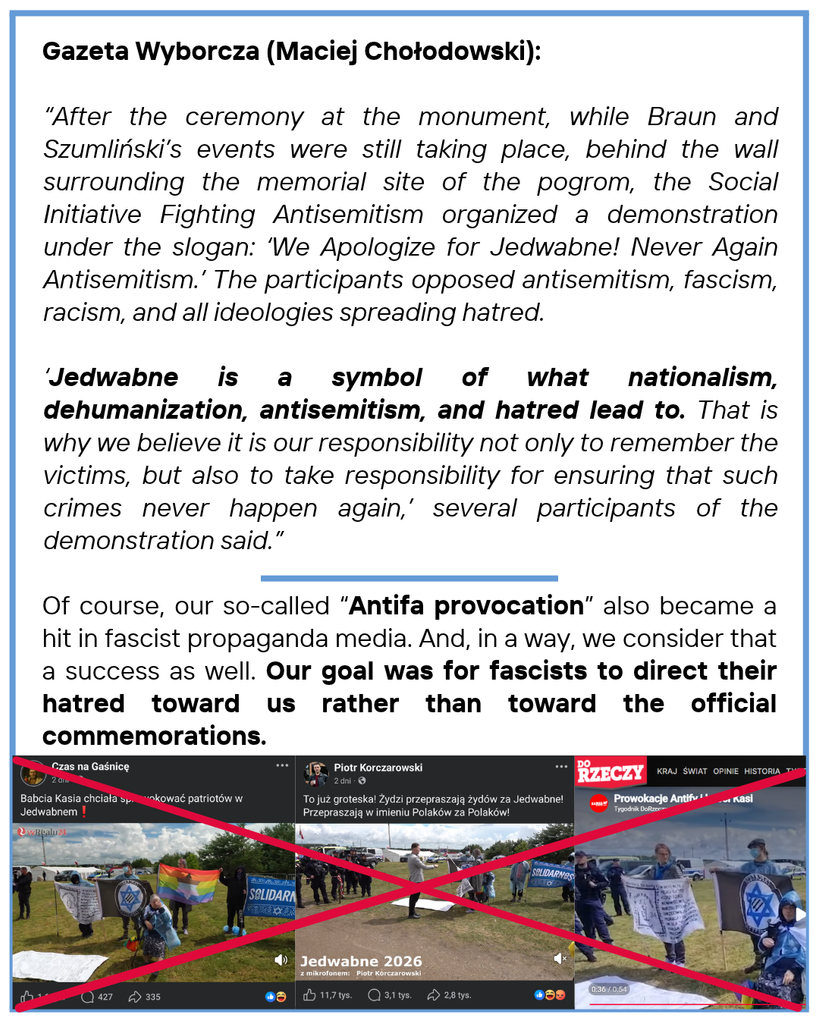
It is a huge success that we finally managed to break through the censorship of our actions in the media, at least a little. Although TVP and 19:30, despite assurances from the journalist who interviewed us, ultimately did not show us—just like Eska and other outlets that spoke with us—and we do not yet know what the coverage from foreign media who interviewed us looked like since those pieces haven’t come out yet, Gazeta Wyborcza and Onet did mention us and quoted our statements:
Onet (Piotr Halicki):
„My life cannot be a provocation to someone else”
Next to them, I see several people with rainbow flags featuring a Star of David in those very colors. I ask whether they aren’t afraid this might be perceived as a political manifestation or a provocation.
— „This is an expression of our solidarity with the Jewish people and the hundreds of murdered victims. It is natural that among them—both now and back then—there are homosexual people. My life cannot be a provocation to someone else. It is those people on the far right who have a problem with it.”
— „I am here primarily to commemorate the victims of the pogrom. But there is also a second issue—we see an attempt to appropriate this space and change the narrative, which is madness. So we want to oppose that as much as we are able,” adds his colleague.
Gazeta Wyborcza (Maciej Chołodowski):
„After the ceremonies at the monument, while Braun’s and Sumliński’s events were still ongoing, behind the low wall surrounding the pogrom memorial site, the Social Initiative Waging the Fight Against Antisemitism (Społeczna Inicjatywa Tocząca Walkę z Antysemityzmem — SITWA), under the slogan 'We apologize for Jedwabne! Never again antisemitism,’ organized a picket opposing antisemitism, fascism, racism, and all hate-mongering ideologies.
’Jedwabne is a symbol of where nationalism, dehumanization, antisemitism, and hatred lead. That is why we believe it is our duty not only to remember the victims, but also to take responsibility so that similar crimes never happen again,’ said several participants of the demonstration.”
Of course, our „Antifa Provocation” also became a hit in the fascists’ propaganda media. And in essence, that is a success for us too. Our intention was for the fascists to focus their hatred on us rather than on the official observances.
We hear voices saying our demonstration might have provoked someone or raised the level of hatred—that this day and this place were not appropriate for loud music and chanting. Yet had we not been there, all of those things would have happened anyway. Sumliński was blasting antisemitic music from a massive stage and powerful sound system, and at both his and Braun’s events, fascists were chanting hateful slogans.
The question we faced was therefore simple: on this day, should the public space be completely filled with fascist, antisemitic, and anti-Zionist content without any response? Or should a voice of opposition ring out—the voice of a handful of people, with a smaller sound system, yet clearly saying „no” to fascism and expressing solidarity with Jews?
We chose the latter. Not to provoke anyone, but so that hatred would not go unanswered. So that people reading about what happened on July 10, 2026, in Jedwabne would receive the message that what the fascists are trying to portray is not true.
It is not true that Jews, along with a handful of friends, ambassadors, and a few politicians, come to Jedwabne, hide in a tent to pray, and flee as quickly as possible, while the entire remaining space is filled with antisemites supposedly representing Poland.
No—we were there too. Residents of Poland of various backgrounds who said:
„We apologize for Jedwabne,
enough fascism, never again antisemitism!”
Dodaj komentarz