
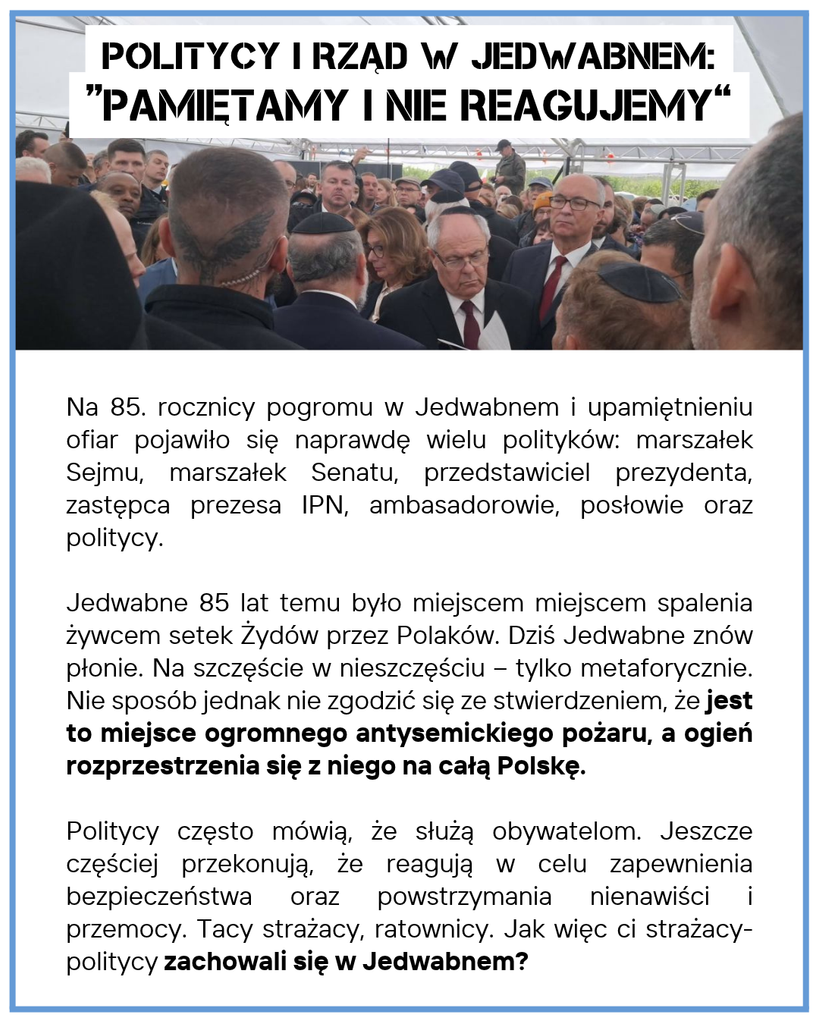
At the 85th anniversary of the Jedwabne pogrom and the commemoration of its victims, a great many politicians appeared: the Marshal of the Sejm, the Marshal of the Senate, a representative of the President, the Deputy President of the Institute of National Remembrance (IPN), ambassadors, MPs, and other politicians.
85 years ago, Jedwabne was the site where hundreds of Jews were burned alive by Poles. Today, Jedwabne is burning again. Fortunately, in this misfortune—only metaphorically. However, it is impossible to disagree with the statement that it is the site of a massive antisemitic fire, and the flames are spreading from there across all of Poland.
Politicians often say that they serve the citizens. Even more often, they claim that they react to ensure safety and stop hatred and violence—acting like firefighters, rescuers. So how did these politician-firefighters behave in Jedwabne?
They arrived at the scene of the fire in expensive, beautiful vehicles, stepped out proudly, and then stood next to the residents who had escaped the fire at the last moment and were watching the building burn. And our politician-firefighters stood beside them, patting the residents on the shoulder.
They passively watched not only as the building burned, but also as some thugs carried over canisters of gasoline and threw them into the fire, trying to set neighboring houses ablaze. They did not try to stop anyone, did not call for backup, and did not even unroll a fire hose.
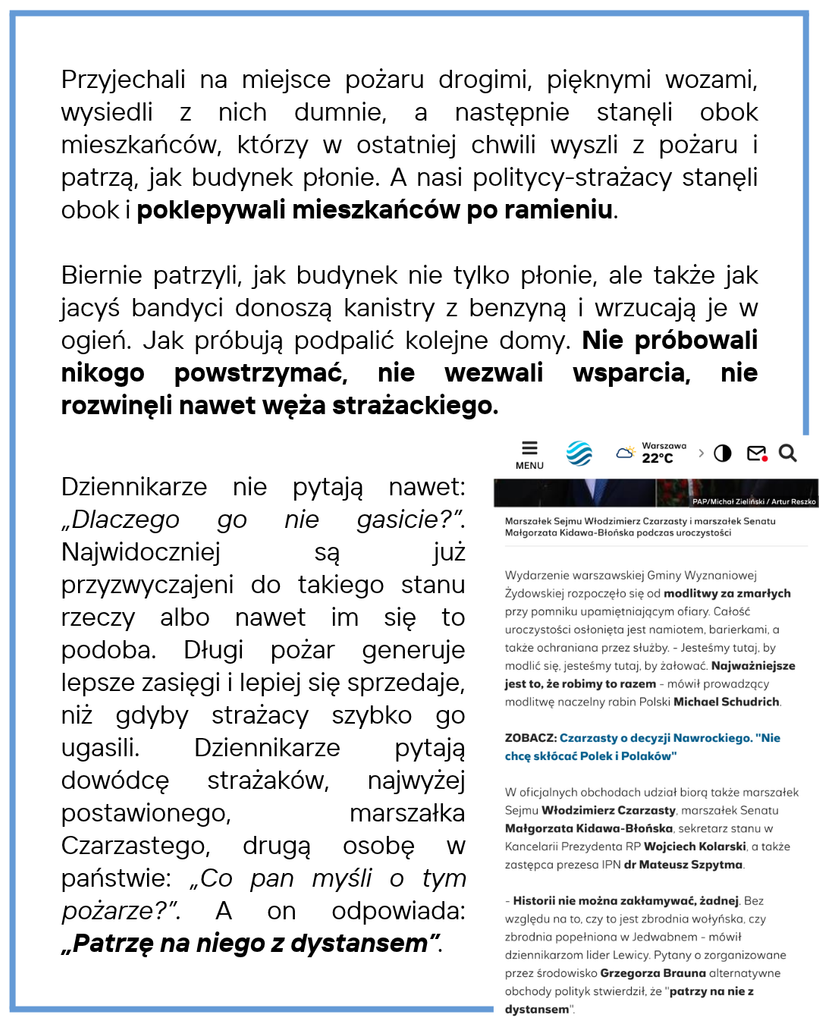
Journalists don’t even ask: „Why aren’t you putting it out?” Evidently, they are already used to this state of affairs, or perhaps they even like it. A prolonged fire generates better reach and sells better than if the firefighters quickly extinguished it. Journalists ask the chief of the firefighters, the highest-ranking one, Marshal Czarzasty, the second most important person in the state: „What do you think about this fire?” And he replies: „I look at it with detachment.”
The residents can no longer bear to watch and leave the scene, and the firefighters drive off right behind them. Before departing, they tell these people: „After all, we came. We were with you. We showed that this matter is important to us. What more were we supposed to do?”
Mere presence is not action. It is not enough to show up at the scene of a tragedy and pat mourners on the back if, at the same time, hatred is allowed to unfold unhindered in plain sight. When someone has a duty to react, passivity is not neutrality—it becomes complicity in that hatred.
Stepping out of this firefighter allegory, we emphasize our complete respect for that service and its heroes, and we apologize for insulting them by comparing politicians to them. However, we could not find a better allegory, especially since politicians and the government so often describe themselves as putting out fires and taking care of citizens.
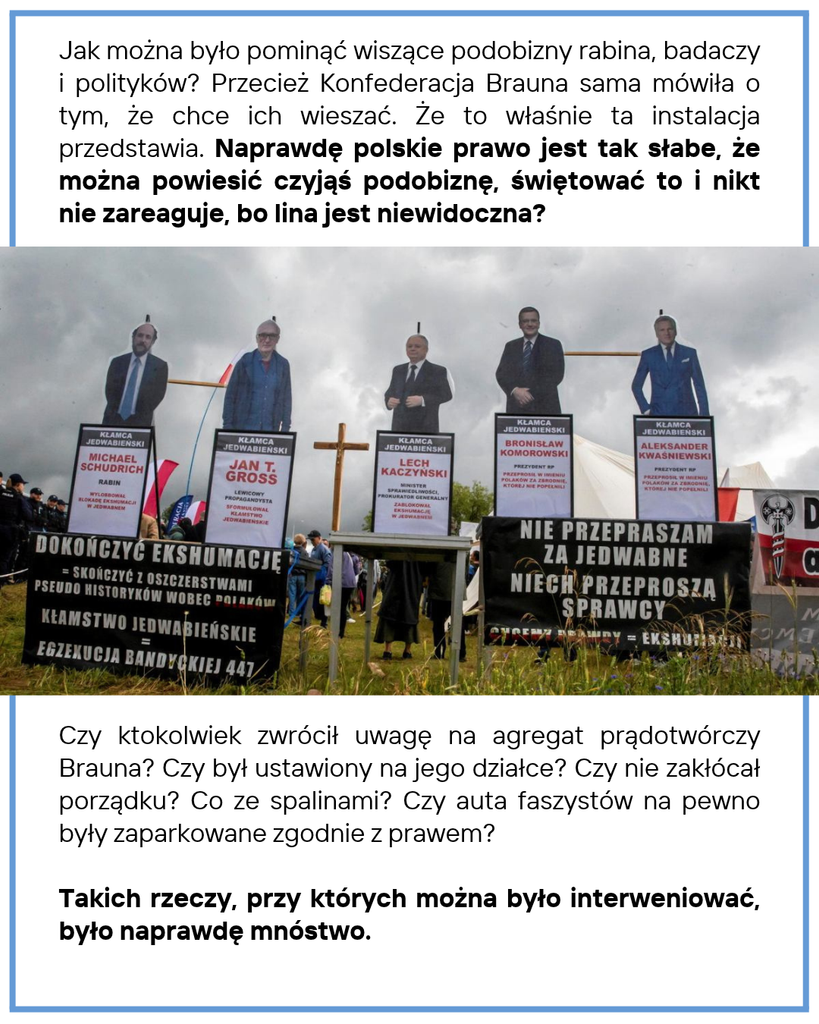
So we ask once again, and more simply: why did no one carry out a parliamentary intervention? Why did no one demand the removal of banners, T-shirts, and books containing content inciting hatred and violence, denying the Holocaust, promoting fascism and totalitarian regimes, and breaking the law? How could anyone overlook the hanging effigies of a rabbi, researchers, and politicians? After all, Braun’s Confederation itself said they wanted to hang them—that this is precisely what the installation depicts. Is Polish law really so weak that someone can hang a person’s effigy, celebrate it, and no one will react just because the rope is invisible?
Did anyone pay attention to Braun’s power generator? Was it placed on his own plot of land? Was it not disturbing the peace? What about the exhaust fumes? Were the fascists’ cars definitely parked in accordance with the law? There were truly countless things one could have intervened over.
Someone might defend themselves by saying they did not want an argument or political commotion on that day, that they did not want to expose the Jewish community to it. But that excuses nothing. A political commotion was already happening that day. Antisemites and fascists were broadcasting their hateful sewage through massive loudspeakers and took over the place.
There was time to react after the commemoration. One could have, just as we did, waited until the Jewish community departed so they would not have to witness the argument and potential violence that might have erupted during a parliamentary intervention and other actions.
Why did you, politicians—including those governing this country—simply run away? You capitulated to the fascists. You allowed them to act unhindered. In other words, you gave tacit approval to fascism and antisemitism, even though you had the opportunity to take so many different actions.
The second most important person in the state, Marshal of the Sejm Czarzasty, the leader of a left-wing party, did nothing. We understand that a left-wing MP from the Jewish community, Anna Maria Żukowska, might not have had the strength to act that day. But the Marshal of the Sejm? With the Marshal’s Guard?
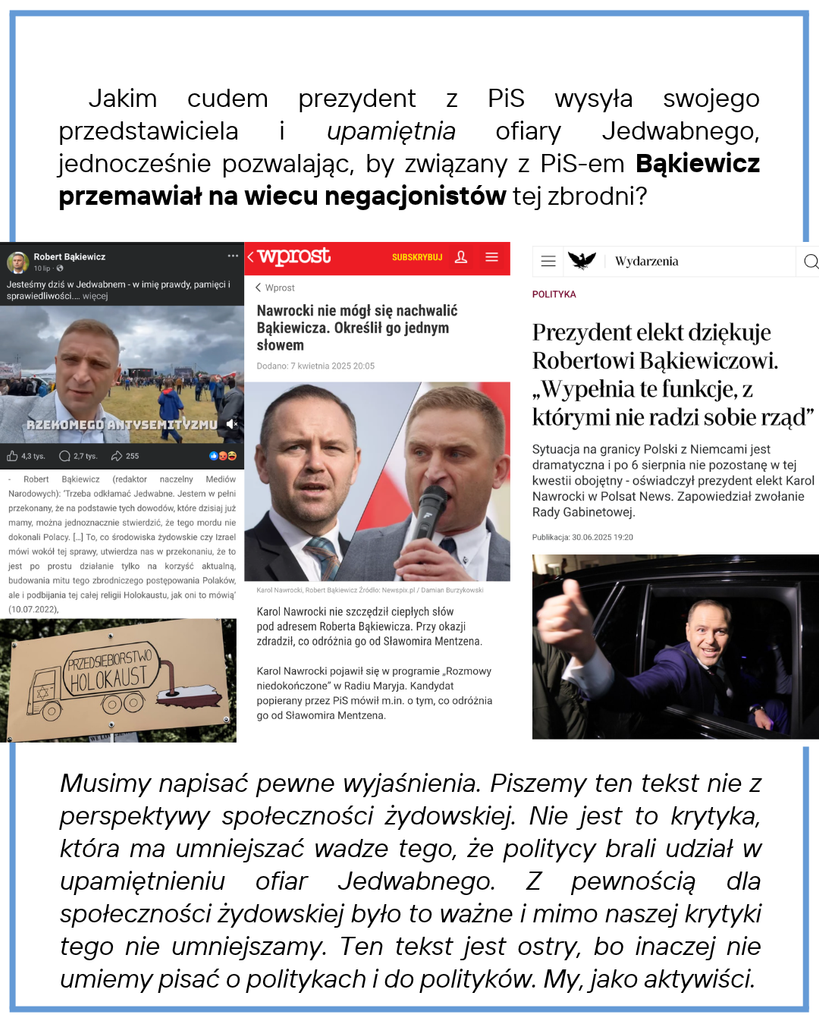
How on earth does a president from PiS send his representative and commemorate the victims of Jedwabne, while at the same time allowing PiS-affiliated Bąkiewicz to speak at a rally of deniers of this crime?
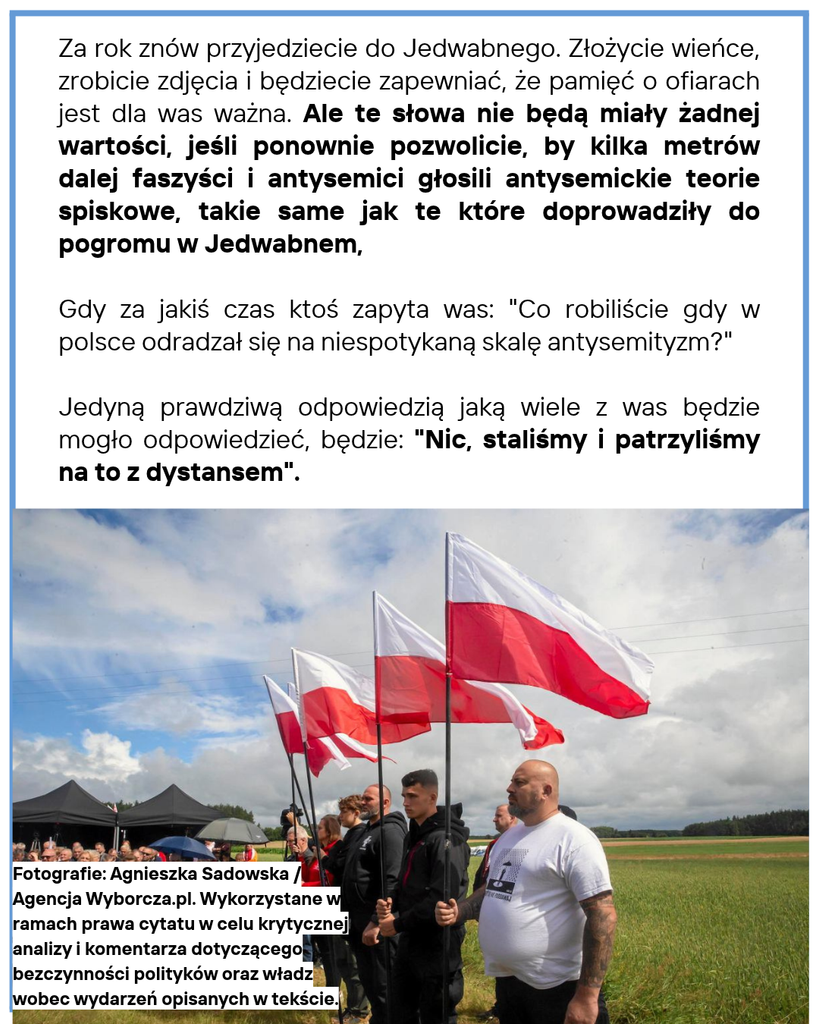
Next year, you will come to Jedwabne again. You will lay wreaths, take photos, and assure everyone that remembering the victims is important to you. But those words will hold no value if you once again allow fascists and antisemites just a few meters away to preach antisemitic conspiracy theories—the very same ones that led to the pogrom in Jedwabne.
When, some time from now, someone asks you: „What were you doing when antisemitism was reviving in Poland on an unprecedented scale?”
The only true answer many of you will be able to give will be: „Nothing, we stood there and looked at it with detachment.”
(We must add a certain clarification. We are not writing this text from the perspective of the Jewish community. This is not criticism meant to diminish the importance of politicians taking part in commemorating the victims of Jedwabne. It was certainly important to the Jewish community, and despite our criticism, we do not downplay that. This text is sharp because we do not know how to write about politicians and to politicians any other way—we, as activists.)
Dodaj komentarz